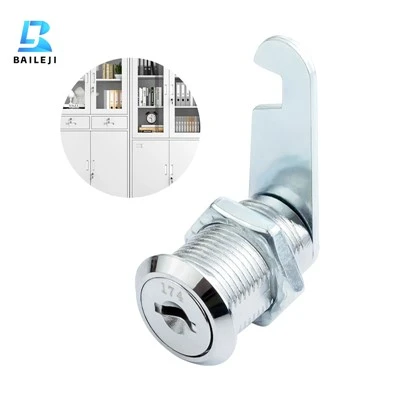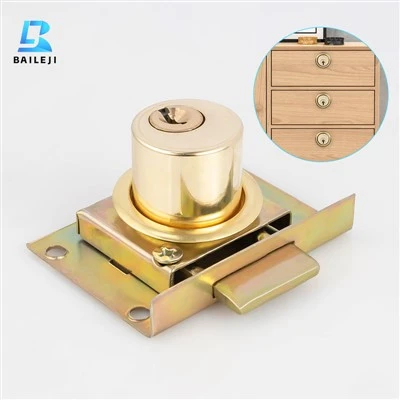
Although there are many types of drawer locks, the installation procedures are largely the same. Following the installation instructions below, we'll install a drawer lock ourselves.
⑴ Preparations before installation: First, identify whether the lock is a drawer lock by checking that the keyhole and bolt opening directions are consistent to avoid confusion with cabinet locks. Open the lock several times with the key to check the smooth operation of all transmission parts. Check the manual to ensure all accessories are complete. Prepare the following tools for installation: wood drill, hammer, hand saw, screwdriver, wood chisel, and measuring tape.
⑵ Installation: Handle with care during installation to avoid damaging the paint on the furniture surface. First, locate the center position of the lock cylinder 200mm from the top edge of the drawer and drill a through hole using a 25mm wood drill. Using the center line of the lock cylinder as the axis of symmetry, draw the inlay position according to the width of the lock box and base plate. Then, using the drawer front as a reference, draw the depth of the inlay groove according to the length of the lock cylinder and the thickness of the lock box. After drawing the paper, use a handsaw to cut a slit along the dimension line on the back of the drawer front. Use a chisel to remove the middle section, creating grooves for the base plate and lock box.
Drawers with built-in locks do not need handles; a key can be used instead. To open the drawer, insert the key into the lock cylinder and rotate it 360 degrees clockwise until the bolt is fully retracted. Then, rotate the key counter-clockwise and pull it to open the drawer. After opening the drawer, turn the key clockwise to the open position and remove it.
To lock the drawer, close it manually, insert the key, rotate it 360 degrees counter-clockwise, and pull it out to lock the drawer.
A drawer lock is a device used to lock drawers. It is a type of lock placed on openable and closable objects to close a specific space or appliance, requiring a key or combination to open. While it protects the privacy and security of our belongings, it can also cause inconvenience, such as when the lock cannot be opened.